

If you’ve looked into non-surgical options for knee or hip arthritis, you’ve probably come across two familiar names: platelet-rich plasma (PRP) and hyaluronic acid (HA). Both are injections some patients use to try to ease joint pain, and some doctors combine them, hoping the two work better together than either does alone.
Mr Al’Khafaji was proud to take part in a laboratory study published this month in Bone & Joint Research that dug into exactly how these two treatments interact — and specifically, whether hyaluronic acid used makes a difference. Here’s what we found, and what it means for patients.
A quick refresher: what are PRP and HA?
PRP is made from a small sample of your own blood. It’s spun down in a centrifuge to concentrate the platelets, which release growth factors and signaling proteins (cytokines) that are thought to support tissue healing and calm inflammation.
HA is a naturally occurring substance already found in your joint fluid, where it acts as an anti-inflammatory and cartilage nutrient. As an injection, it’s sometimes used to try to reduce arthritic joint pain.
HA injections come in different molecular weights — think of this as the size of the HA molecules. Low molecular weight HA (LMWHA) and high molecular weight HA (HMWHA) are both used clinically, however, higher molecular weight formulations might have a stronger anti-inflammatory effect.
What we set out to answer
Some clinicians combine PRP and HA in the same treatment session, on the theory that HA might help “activate” PRP and encourage it to release more of its beneficial growth factors. But there’s been very little direct evidence on whether the size of the HA molecule changes that effect or if it has any effect at all.
So our research team mixed PRP from healthy volunteer donors with either low or high molecular weight HA in the lab, and measured what was released over three days.
What we actually found
There were two main takeaways:
1. Adding HA — of either type — did not improve PRP’s cytokine profile.
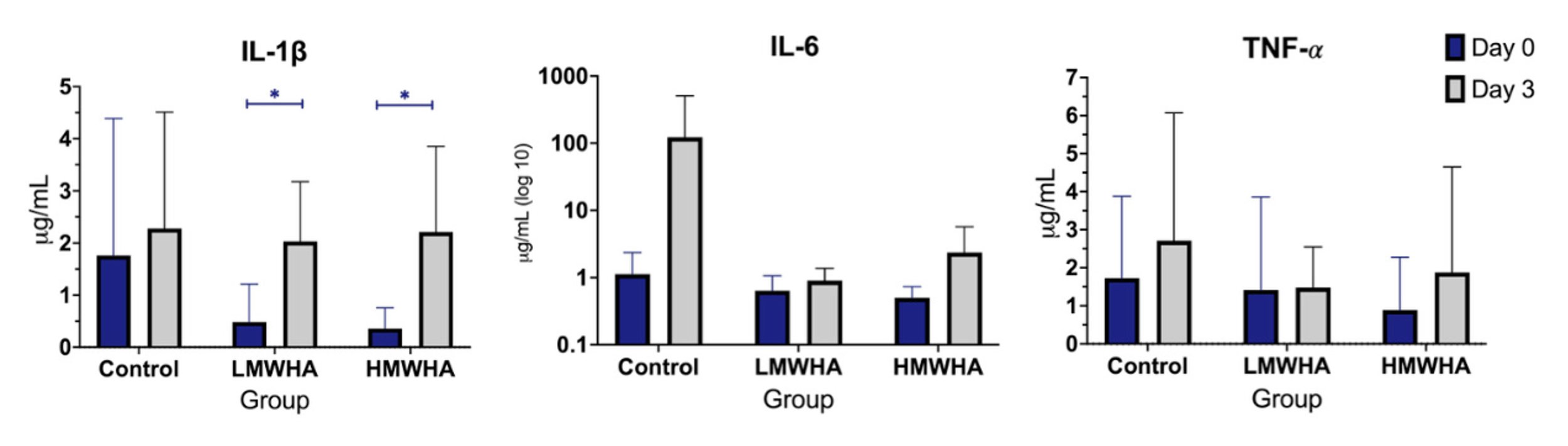
We tracked eight different growth factors and cytokines. Across the board, adding hyaluronic acid didn’t push PRP toward a “better” or more favorable healing profile compared to PRP alone:
The anti-inflammatory signals we tracked (IL-1RA and IL-10) rose significantly over the three days in every group — including the PRP-alone (control) group — with no significant difference between the PRP-alone group and either HA group. So this rise appears to come from the PRP itself, not from adding HA.
Several other markers (IGFBP1, IL-6, TGF-β1, TNF-α) showed no significant differences between the PRP-alone group and either HA group at any point.
One growth factor important for tissue repair, PDGF-BB, actually dropped off faster when HA was added compared to PRP alone — a signal that HA may be interacting with PRP components in a way that isn’t obviously beneficial.
A pro-inflammatory marker, IL-1β, rose over time only in the HA-containing groups, not in the PRP-alone group — another finding that runs counter to the idea that adding HA makes PRP more anti-inflammatory.
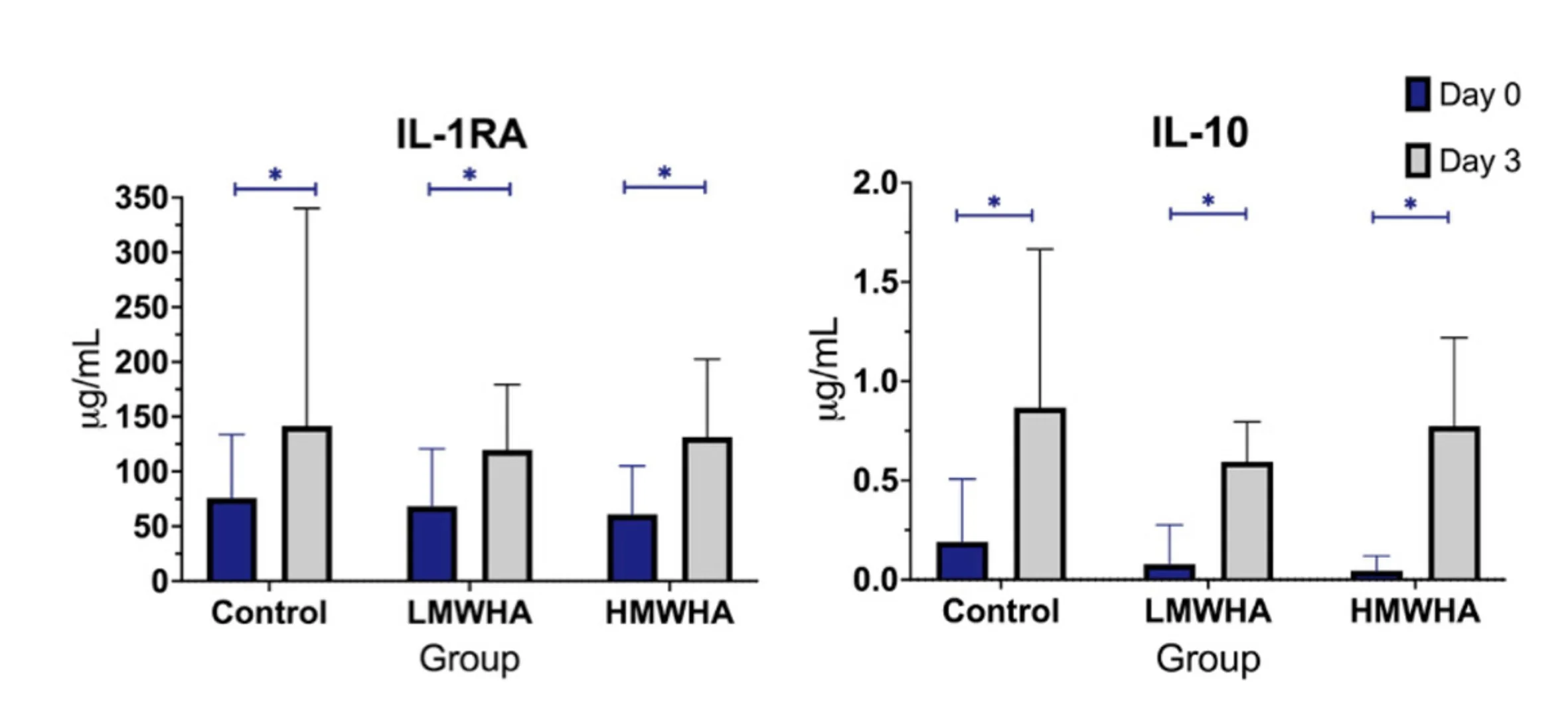
In short: in this lab setting, mixing HA into PRP did not enhance PRP’s biological effect the way the “combined therapy” theory predicts.
2. It made no difference which type of HA (low vs. high molecular weight) was used.
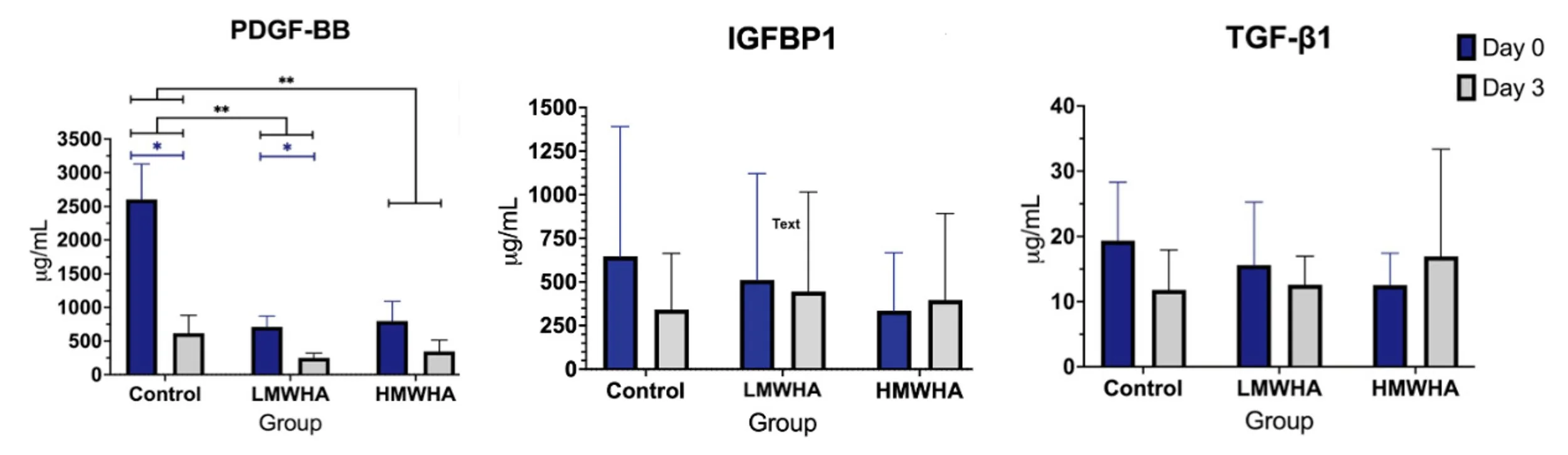
We specifically compared low molecular weight HA against high molecular weight HA, expecting the higher molecular weight version to outperform, based on prior evidence in HA-alone research. Instead:
For every single marker measured — the anabolic growth factors, the pro-inflammatory cytokines, and the anti-inflammatory cytokines — there was no statistically significant difference between the low and high molecular weight HA groups, at either the 2-hour or 72-hour mark.
Even for PDGF-BB, where HA (of either kind) changed the profile compared to PRP alone, low and high molecular weight HA behaved the same as each other.
In plain terms: Neither LMWHA or HMWHA improves the biochemical profile of PRP injections.
Why this matters for patients
This was a laboratory (in vitro) study, not a clinical trial on patients, so it doesn’t tell us how these injections perform in an actual arthritic knee or hip. But it does offer some practical reassurance:
This lab evidence doesn’t support the idea that adding HA to PRP boosts its biological, healing-associated profile — at least not through the mechanisms we measured. That doesn’t mean combined injections don’t help patients clinically, but it does mean the “synergy” often assumed in marketing and practice isn’t yet backed by this kind of evidence.
It’s a reminder that professional guidelines on PRP and HA are still evolving and, at times, conflicting — which is exactly why studies like this one matter.
We’re grateful to have contributed to this study, which provides improvements in evidence-based care.
Reference: Ellenbogen DJ, Puri S, Chatterji R, et al. An analysis of the cytokine profile of platelet-rich plasma when combined in vitro with low versus high molecular weight hyaluronic acid. Bone Joint Res. 2026;15(8):1067-1073. Read the full article: https://boneandjoint.org.uk/Article/10.1302/2046-3758.158.BJR-2025-0500.R2
