

Core Decompression/Bone Grafting of the Hip
What is Avascular Necrosis of the Hip?
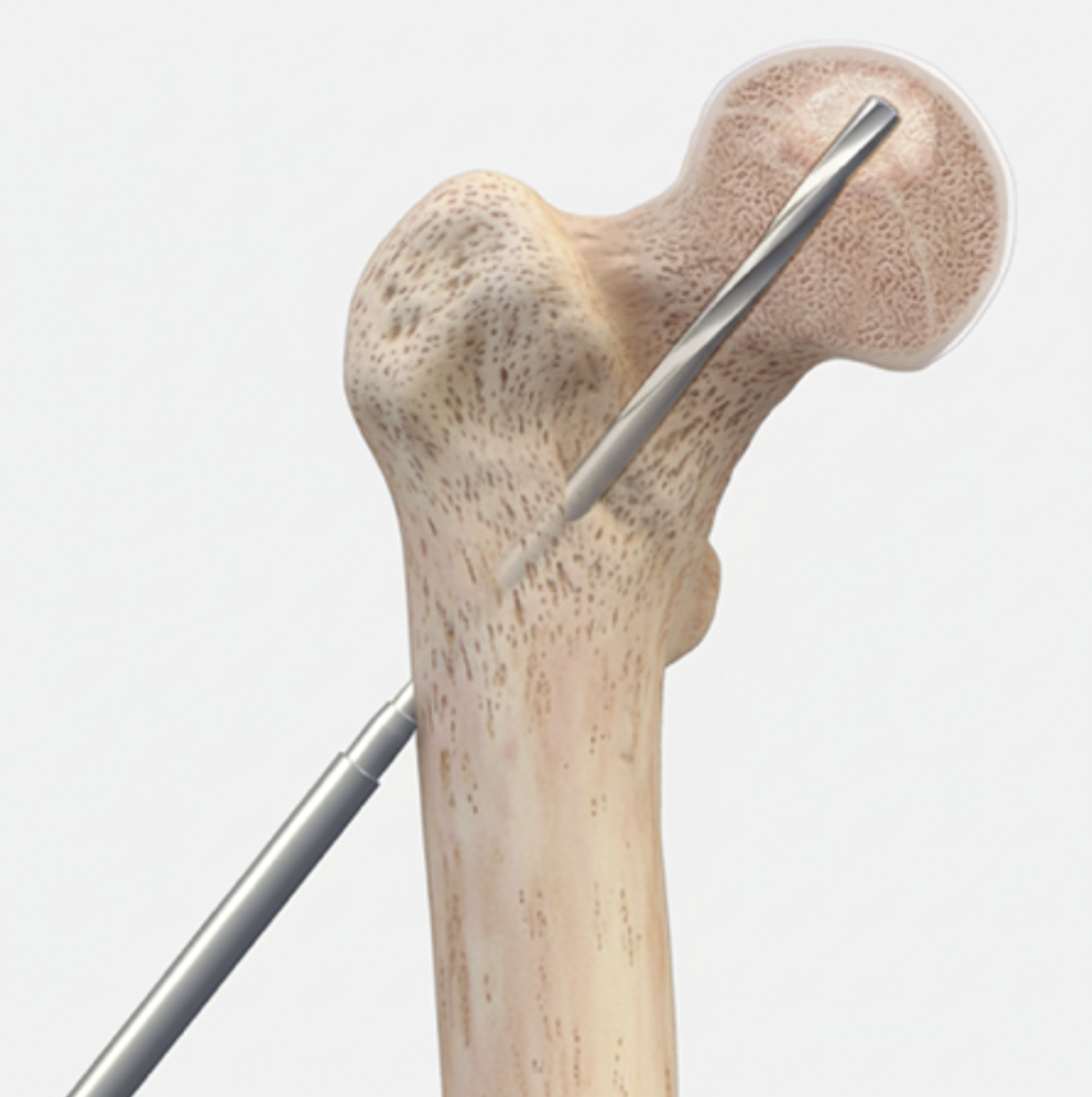
Avascular necrosis (AVN) — also known as osteonecrosis — occurs when there is a loss of blood supply to the femoral head, the ball portion of the hip joint.
Without adequate blood flow, the bone tissue becomes weak and may collapse, leading to pain, stiffness, and arthritis over time.
Common causes include:
Trauma (such as a hip fracture or dislocation)
Corticosteroid use or alcohol abuse
Certain blood disorders, autoimmune conditions, or idiopathic (unknown) causes
Who Should Get a Core Decompression / Bone Grafting for Avascular Necrosis?
A core decompression and/or bone grafting is recommended for patients with early-stage AVN, before significant bone collapse has occurred. This procedure aims to restore blood flow, relieve pressure inside the bone, and promote new bone formation.
You may be a candidate if:
You have AVN confirmed on MRI without collapse of the femoral head
You experience hip pain that limits activity
You are younger or active where preserving your natural hip is reasonable compared to a total hip replacement
Non-surgical options such as medication or activity modification have not relieved symptoms
For more advanced disease with collapse or arthritis, a total hip replacement may be more appropriate.
How Is Core Decompression / Bone Grafting Performed?
Surgery is performed under general or regional anaesthesia.
The procedure involves:
Making a small incision on the side of the hip.
Inserting a narrow drill into the femoral head to create a small channel (core) that relieves pressure and stimulates blood flow.
The decompressed channel may then be filled with bone graft or bone-stimulating materials such as autograft (your own bone), allograft (donor bone), or biologic agents (e.g., bone marrow aspirate).
This encourages new bone growth and revascularisation of the affected area. The incision is then closed and covered with a sterile dressing.
For larger lesions, an open bone graft may be recommended via an anterior incision. A window will be cut in the neck of the femur to access the head. The dead bone will be removed and bone graft will be placed in the remaining void to aid in the healing of the lesion.
How to Manage My Wound
Dressings: Keep your waterproof dressing on for 2 weeks.
Showering: You may shower the next day if the waterproof dressing remains on. Avoid soaking the wound (no baths or pools) for 4 weeks.
Monitoring: Inspect the incision daily for infection, such as redness, swelling, or foul-smelling drainage. You may have a fevers if you have an infection. Please contact our offices if you have any of these symptoms
Sutures: Dissolvable sutures will be used and thus will not require removal. Some of these sutures will not dissolve and may be pushed out of your skin naturally. You will need a wound check with your GP in 2 week.
Clothing: Avoid tight clothing or pressure over the wound site for 4-6 weeks.
What Is the Recovery for Core Decompression / Bone Grafting?
Recovery depends on the size and stage of the lesion and whether bone grafting or biologics were used.
Typical phases:
Weeks 0–6: Limited or non-weight bearing on crutches to protect the healing bone. You should start stationary biking and working on active range of motion right away.
Weeks 6–12: Gradual return to partial/full weight bearing. Start strengthening with the guidance of a physiotherapist.
Months 3–6: May start running and other lower-demand activities.
After 6 months: Most patients resume higher-impact activities; full recovery may take 6–12 months.
Regular follow-up and imaging help ensure proper healing and early detection of any progression.
When Can I Return to Activities?
Walking (with crutches): Immediately after surgery under partial or non-weight bearing.
Full weight bearing: Typically between 6–12 weeks, depending on bone healing.
Light exercise (stationary bike, pool work): Stationary bike can be started right away. Pool rehab can start in 4 weeks.
Impact activities (running, jumping): Lower impact activities (running) can start in 3-6 months. Higher impact activities (sport) may take 6-12 months to rehabilitate toward.
When Can I Return to Work?
Sedentary work: Usually 2–3 weeks post-surgery if comfortable.
Light manual work: Around 4–8 weeks.
Heavy or physical work: May require 3–6 months, depending on bone healing and rehabilitation progression
When Can I Return to Driving?
You may resume driving (automatic transmission) when you can safely control the vehicle and perform an emergency stop without hesitation — typically:
2-3 weeks after surgery for the left leg, and
8-10 weeks for the right leg
What Complications Occur?
Core decompression and bone grafting are generally safe procedures, but as with any surgery, there are potential risks:
Persistent pain or progression of AVN: The bone may continue to deteriorate despite preservation surgery. This may require considering a total hip replacement to treat the AVN.
Fracture: A small risk exists due to the drilling channel in the femoral head or neck.
Infection: Rare but possible; treated with antibiotics and further surgery if detected early.
Bleeding or haematoma: Usually minor and self-limiting. Rarely will require a blood transfusion.
Nerve or vessel injury
· Deep Vein Thrombosis/Pulmonary Embolism: Preventative measures are used to minimize this risk via blood thinners such as aspirin.